|
EP201
PowerPC Bus Master
Features
- Fully supports PowerPC™ 60x bus protocol, include PowerPC 603,
604, 740, 750 and 8260.
- Designed for ASIC or PLD implementations in various system environments.
- Fully static design with edge triggered flip-flops.
- Automatic bus arbitration for address bus and data bus based
on internal bus request.
- Separate address bus and data bus tenure with individual grant
signals.
- Supports address bus retry and data transfer error.
- Qualified address bus grant and data bus grant through the use
of bus busy signals.
- User specified burst data transfer and single beat data transfer.
- Supports two back-end user request ports with built-in arbitration.
- Efficient back-end bus for internal data transfer.
- Supports bus parking.
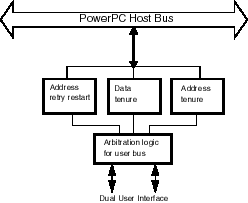
Diagram
Description
The PowerPC bus master is a bus interface unit designed for the PowerPC
host bus. It allows the user to initiate data transfer directly on
the PowerPC CPU bus through a very simple user interface.
The PowerPC bus master arbitrates for the PowerPC address bus before
starting any transfers. It handles separate address and data bus tenure
so that data bus is arbitrated independently from the address bus.
The bus master handles address retry by the CPU or other sources on
the CPU bus. Upon address retry, it automatically re-starts the data
transfer unless an error has occurred.
Single beat, burst data and extended MPC8260 data transfer are supported.
Different data size and transfer types are allowed and can be specified
through an internal back-end bus. There are two user interface ports
provided by the bus master. It allows two different devices to access
the PowerPC bus through a single bus master. The PowerPC bus master contains
arbitration logic to arbitrate between the two request ports.
Optional Features
The following table summarizes the optional features which can be
provided with this PowerPC interface core as required by user application.
| Options</th>
| Description |
Extended data transfer |
MPC8260 extended data transfer |
Dual or single user interface |
Supports one, two or multiple user request ports. |
Address only transfer |
Execute address only transfer on the CPU bus for data snooping. |

|